
 January 29, 2026
There are some in-house Reformed debates that are obscure, and then there are some that are really obscure. For those interested in such debates, the word “supralapsarianism” is usually taken to mean the minority Reformed view that God’s decree of election comes logically before the decree of the fall—in contrast to the majority “infralapsarian” view that election comes logically after the fall. However, there’s another, even more niche, kind of supralapsarianism.
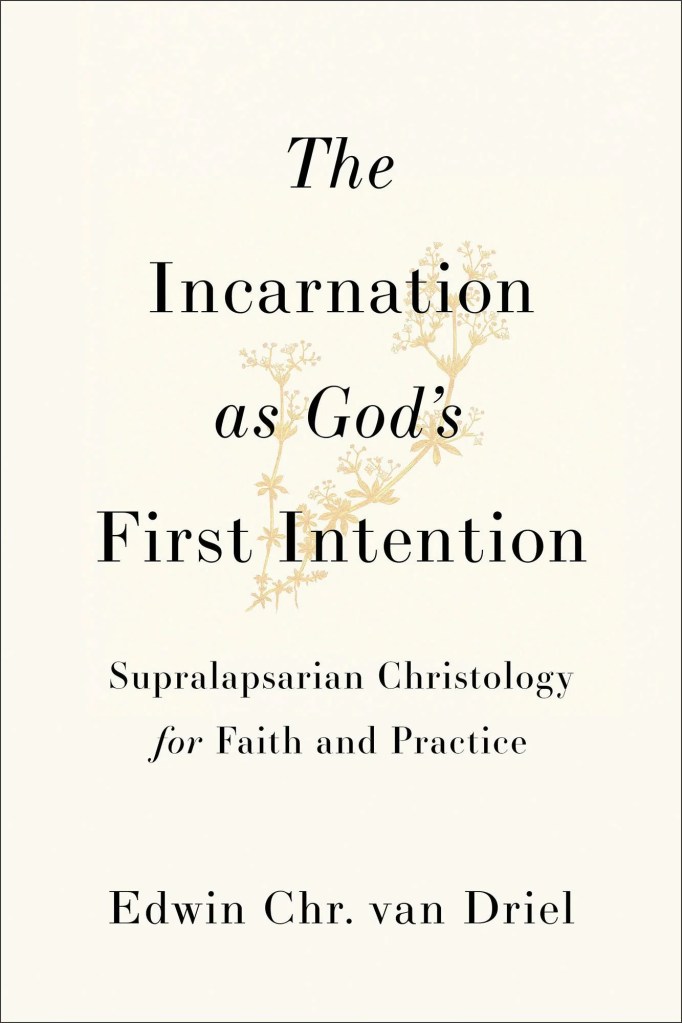
Edwin Chr. van Driel’s The Incarnation as God’s First Intention (Baker, 2025) makes the case for a supralapsarian Christology, referring not to election but to the incarnation as the first of God’s decrees. On this view, God the Son would have become man even if the fall had never happened (that is, even if Adam and Eve had obeyed). While most Christians tend to think of the incarnation merely as God’s response to sin, van Driel urges us to see the incarnation as even more fundamental to God’s purposes. Before all else, God willed to express his love toward himself through creation—hence incarnation. But this was only the first step; God further intended for his self-giving love to be shared not only with the incarnate Son, but also in an extended elect family, “that [Christ] might be the firstborn among many brothers” (Rom. 8:29).
To be sure, this isn’t a very popular view, historically speaking. It’s often associated with lesser-known—and occasionally heterodox—theologians like John Duns Scotus, Andreas Osiander, Friedrich Schleiermacher, and Karl Barth. And yet in recent years supralapsarian Christology has been gaining a more favorable hearing. I first learned of it through Mark Jones, and authors like Phillip Hussey have made a case for it as well.
While some might consider the very idea just a fanciful bit of speculation, I tend to think that it has merit. One of the most compelling arguments for me is the nature of the beatific vision: God created man in such a way that man cannot attain his highest good by his natural powers alone. We depend on a gracious condescension on God’s part, elevating us above our natural powers in order to experience the supreme delight of beholding God face-to-face. And yet the mode of such delight must correspond to our bodily nature. Contrary to Thomas Aquinas’s account of the beatific vision as a purely intellectual beholding of the divine essence, Reformed theologians like John Owen and Jonathan Edwards have made a compelling case that the beatific vision is a sensory beholding of God through the humanity of Christ (see also Samuel Parkison for this argument). It takes only a small logical step to conclude that this would have been necessary for humanity even before the fall.
Van Driel presents this argument along with numerous other arguments. His book is divided into two parts: part 1 provides some historical explorations of various critics and proponents of supralapsarian Christology, and part 2 provides some constructive explorations into various theological loci such as election, trinitarianism, astrotheology(!), atonement, and eschatology.
I found van Driel’s exegetical treatment of Colossians 1:15-20 to be especially intriguing. Paul’s reference to Christ as “firstborn of all creation” (v. 15) has given rise to a variety of interpretations. On the one hand, Arians have used it in order deny the deity of Christ. On the other hand, orthodox Trinitarians have taken it either as a reference to Christ’s status as “supreme heir” over creation, or as a reference to Christ’s eternal generation. Van Driel suggests instead that the title makes best sense as a reference to the incarnation, the first of God’s decrees and the logical foundation for all creation. This would also explain why Paul calls Christ the “image” (eikōn) of God: in his divinity, the Son is just as invisible as the Father, but in his humanity he perfectly images the Father (191-193). A supralapsarian reading of Colossians 1 also better explains why creation is said to be “for” Christ rather than Christ “for” creation (v. 16).
And yet, van Driel perhaps extends his incarnational exegesis too far. Many other biblical texts traditionally taken as references to the immanent Trinitarian processions, van Driel sees as references to the economic Trinitarian relations. Even the very title “Son” is recast in incarnational terms: “…Paul invokes the terms Father and Son to refer to the God who sends and the God who has been sent only in the context of God’s relationship to and presence in creation through incarnation. It is in incarnational theology, not Trinitarian theology, that they are located” (197). On van Driel’s reading, one wonders whether there is any biblical warrant for the doctrine of eternal generation at all.
There are other problems with van Driel’s argument. In his chapter on the Atonement, he challenges the doctrines of penal substitution and propitiation, favoring instead the “just forgive” view as promoted by Lutheran theologian Gerhard Forde and fellow supralapsarian Samuel Wells (232-236). On this view, the cross is not about satisfying some requirement on God’s part (e.g. his justice or wrath), but is rather the consequence of God’s determination to pursue relationship with those who reject him. The cross happens because of us, not because of God. In effect, the cross becomes an obstacle to reconciliation rather than the means to it—albeit an obstacle overcome through Christ’s resurrection. Given van Driel’s status as an ordained minister in the mainline PC(USA), his view of the Atonement is understandable. But for those of us more closely aligned with the confessional Reformed tradition, it will raise serious questions about the character of God, the nature of sin, as well as the fate of the non-elect.
Another serious question concerns one of the primary rationales that drives van Driel’s supralapsarian project. According to the logic of infralapsarian Christology, Christ’s incarnation is grounded in his redemptive work—that is, Christ became man because man became sinful. But this implies that our eschatological goal—beholding God in the face of Christ—depends on sin. In effect, sin makes the redeemed believer’s destiny better than unfallen Adam’s destiny. Van Driel believes that such a conclusion is “theologically incongruent” (7), but it is avoided by his own supralapsarian alternative, wherein unfallen humanity would have shared exactly the same destiny as redeemed humanity.
But if this is the case, then why did God ordain sin and redemption in the first place? Van Driel’s chapter on eschatology describes our ultimate future glory as if sin never happened. Our memories of sin—as well as Christ’s wounds—will be completely erased (258-266). It seems as though van Driel reduces the entire order of sin and redemption to a mere interruption, distraction, or parenthesis in God’s cosmic plan. In effect, glorified saints will eventually lose all conception of what it means for God to be merciful. This is why I tend to prefer Phillip Hussey’s felix culpa view: the redeemed believer’s destiny is indeed better than Adam’s destiny, because we will have a richer understanding of God’s mercy toward us, and of his justice toward the non-elect.
In sum, despite my reservations over some of his constructive explorations, I’m persuaded that van Driel’s overall thesis is correct: Christ’s incarnation is first in the order of God’s decrees. Those seeking a guide closer to confessional orthodoxy might wish to consult Hussey instead. Nevertheless, van Driel’s work is certainly a valuable contribution in its own right, and discerning readers will doubtlessly appreciate many of his positive insights on the subject.


 Allkirk Network
No comments yet... Be the first to leave a reply!